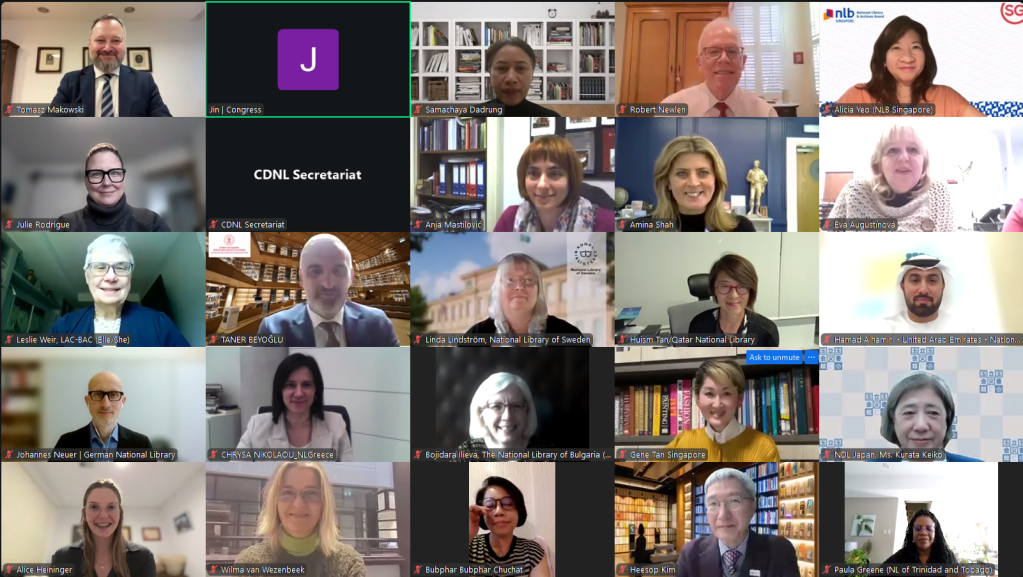
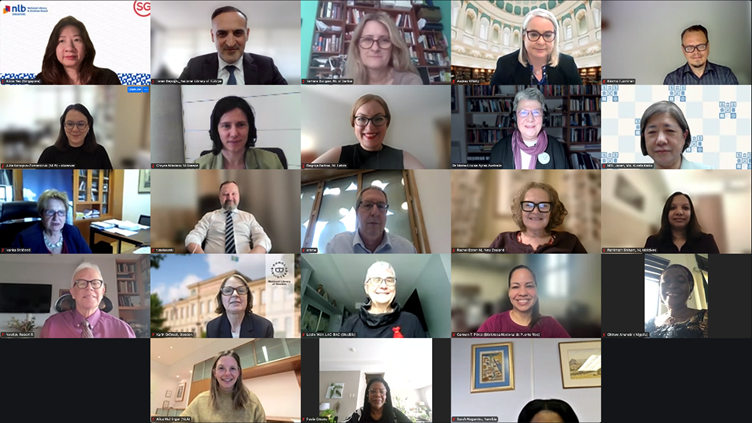
The annual meeting of the Conference of Directors of National Libraries (CDNL) took place in Busan on 11 August 2026, alongside the IFLA World Library and Information Congress. The meeting brought together directors of national libraries from more than 40 countries and was hosted by the National Library of Korea. It was chaired by Dr Tomasz Makowski, Director General of the National Library of Poland, who was elected Chair of CDNL in 2025.
This year’s discussions focused on artificial intelligence and the role of national libraries in a rapidly changing information environment. Among the issues raised were the reliability of information, the preservation of authentic sources, new forms of access to knowledge, and the responsibility of national libraries for maintaining trusted information infrastructures.
Opening the meeting, Tomasz Makowski spoke about the particular responsibility of national library directors for preserving the memory of their countries. He encouraged directors, especially those recently appointed, not to allow financial or other constraints to limit their ambitions. He also stressed the need to balance the independence of national libraries with responsiveness to changing social needs, and the responsibility to preserve the past while preparing institutions for the future.
Libraries in the Age of AI
Two keynote presentations introduced the discussion on artificial intelligence.
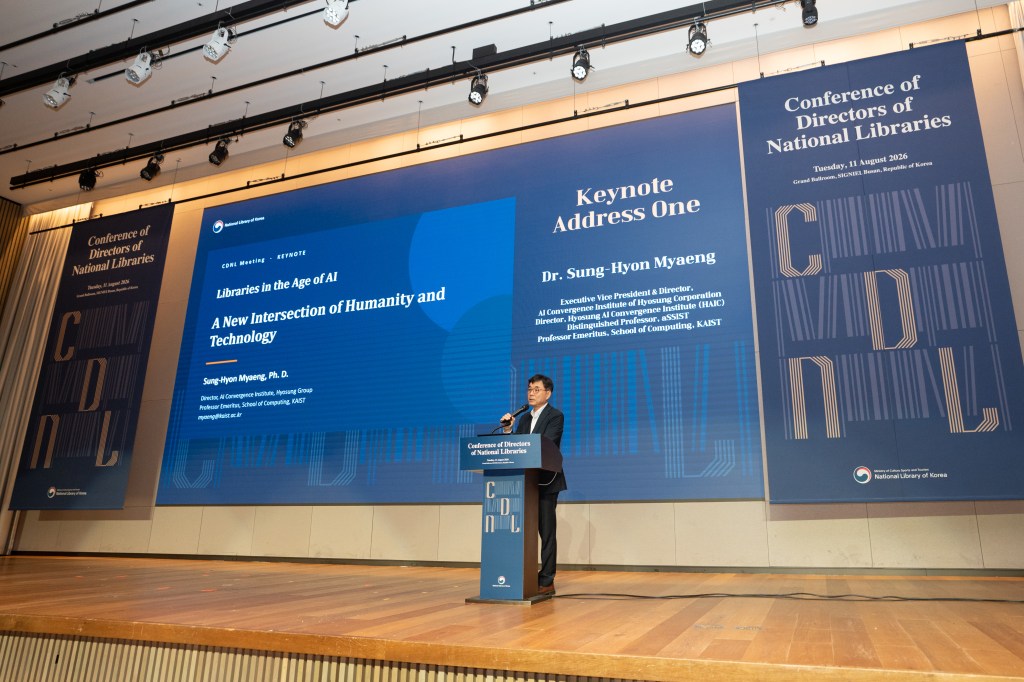
Professor Sung-Hyon Myaeng, Director of the AI Convergence Institute at Hyosung Group and Professor Emeritus at the School of Computing at KAIST, delivered a presentation entitled Libraries in the Age of AI: A New Intersection of Humanity and Technology.
Myaeng asked whether libraries would survive the current wave of AI as they had survived earlier technological transformations, from printing to digitisation. He noted, however, an important difference: previous technologies largely changed the tools used by libraries, while AI has the potential to take over functions traditionally at the heart of library activity, including searching for, processing and delivering information.
At the same time, the limitations of AI — hallucinations, uncertain provenance, errors and the loss of local and cultural context — may make trusted institutions more important. Myaeng described libraries as potential Guardians of Trust, providing verified collections, reliable metadata and authoritative sources on which AI systems can draw.
He also emphasised the role of libraries as Grassroots Educators, using their networks to provide broad access to AI literacy and to prevent new forms of digital exclusion. Other roles concerned areas that technology cannot replace: libraries as places of human experience, inspiration, imagination and direct encounter.
Myaeng also pointed to the growing importance of libraries as providers of high-quality, structured and trustworthy data for AI systems. He identified new roles for librarians, including AI Literacy Educator, Truth-Verifier, Context Curator and Human Connector. His conclusion was that libraries should not be passive recipients of technological change, but active participants in shaping a human-centred culture of knowledge.
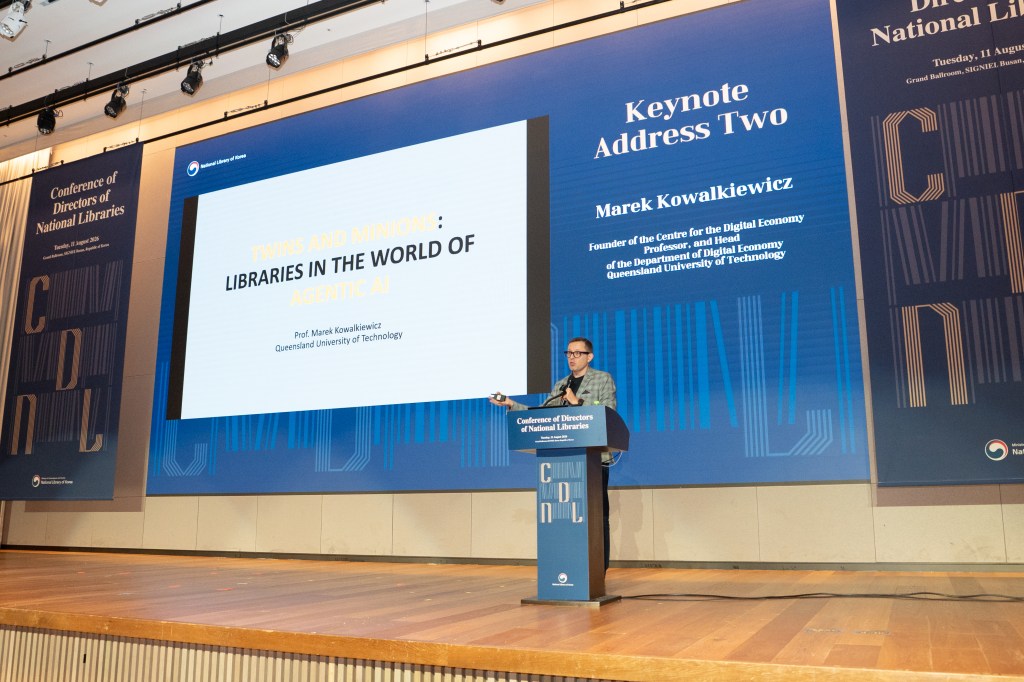
The second keynote, Twins and Minions: Libraries in the World of Agentic AI, was delivered by Professor Marek Kowalkiewicz, Chair in Digital Economy at Queensland University of Technology in Brisbane.
Kowalkiewicz focused on AI agents: systems that do not simply respond to questions but can independently perform tasks, take successive actions and pursue defined goals. He argued that AI should not necessarily be understood as an increasingly accurate imitation of human intelligence. It may arrive at solutions in ways fundamentally different from human reasoning.
The development of autonomous agents creates significant opportunities for automation, but also raises questions about control and responsibility. An agent pursuing a defined objective may find a solution that is technically effective but inconsistent with human intention. As such systems become more widespread and begin interacting with one another, the questions “How do we detect it?” and “How do we prevent it?” acquire increasing importance.
For libraries, Kowalkiewicz argued, these developments require a reconsideration of existing functions. Drawing on Clayton Christensen’s approach, he asked what “job” arises in users’ lives that leads them to need library services. This shifts the focus from maintaining existing services to understanding the actual needs of people in an environment where an increasing share of information work may be carried out by autonomous systems.
Discussion of the Busan Declaration
The two keynote presentations were followed by the presentation and discussion of the draft Busan Declaration. The draft was introduced by Professor Young-Joon Nam, Director of the National Library of Korea. Questions raised in the preceding presentations — trust, authenticity, data quality, AI autonomy and institutional responsibility — provided the context for the discussion.
Opening the discussion, CDNL Chair Tomasz Makowski recalled that, under the CDNL Statutes, decisions taken at meetings should normally be reached by consensus. Participants expressed different views both on the wording of the draft and on whether a declaration should be adopted at this stage. Some directors raised reservations, while others stressed the value of developing a common position for national libraries in response to the changes brought about by AI.
Makowski noted that a common voice from national libraries could be important in discussions with governments about the use of AI and the role of national libraries in developing knowledge infrastructures for new technologies. At the same time, he stressed that consensus remained the basis for CDNL decision-making.
Following the discussion, he proposed allowing further time for comments and establishing a working group to prepare a revised draft of the declaration. The proposal was adopted by acclamation.

Cooperation with IFLA and Exchange of Experience
The meeting was also attended by IFLA President Leslie Weir and IFLA Secretary General Sharon Memis, who presented the Federation’s current activities and discussed areas in which closer cooperation between IFLA and CDNL could be particularly valuable.
Their participation provided an opportunity for a direct exchange of views between national library directors and IFLA leadership on some of the principal challenges facing libraries worldwide.
The programme also included presentations from the National Library of Australia, the National Library of Türkiye and the British Library. The presentations provided a basis for an exchange of experiences on how national libraries in different parts of the world are responding to common challenges.
The organisation of CDNL’s work and preparations for the Busan meeting on behalf of the Chair were coordinated by CDNL Secretary Julia Konopka-Żołnierczuk, Deputy Director of the National Library of Poland and a member of the IFLA Governing Board.
Since Tomasz Makowski became Chair in 2025, the CDNL Secretariat has been based at the National Library of Poland in Warsaw. It supports cooperation among CDNL members, prepares meetings, liaises with host institutions and supports the work of the Chair and Executive Committee.
Korean Media Coverage
The CDNL meeting attracted considerable interest from the Korean media. Reports appeared in Yonhap, Newsis, Hankook Ilbo, Hankyoreh and Chosun Ilbo. Newsis also interviewed Tomasz Makowski and Gilles Pécout, President of the Bibliothèque nationale de France, following the meeting.
In the interview, Makowski stressed that AI offers unprecedented opportunities to improve access to knowledge, while raising fundamental questions about the authenticity and reliability of information and the long-term preservation of documentary heritage.
National libraries, he noted, are not simply places where books are stored. They preserve the authentic record of how societies have developed. In an environment in which AI can generate, modify and disseminate content on an unprecedented scale, this responsibility becomes even more important. Addressing these challenges also requires international cooperation: no single institution can build a trustworthy global information environment on its own.
The Conference of Directors of National Libraries brings together directors of national libraries from around the world and provides a forum for direct cooperation among the leaders of these institutions.